Leave Your Message
High-clamp load fasteners engineered with optimized expansion bulbing and knurled anti-rotation splines for rigorous dynamic vehicle environments.
Modern automotive architecture is traversing an unprecedented revolution. The rapid emergence of battery electric vehicles (BEVs), hybrid platforms, and autonomous light-weight commercial trucks introduces intense vibrational dynamics and harsh operational harmonics. Unlike traditional internal combustion powertrains that emit uniform high-frequency vibration, electric vehicles produce complex low-frequency torque oscillations, sudden regenerative braking shocks, and high acoustic resonance that directly propagate through the chassis and Body-in-White (BIW) frameworks.
Standard tapped threads or thin-gauge sheet nuts are fundamentally prone to rotational loosening under continuous transverse vibration—a phenomenon formally recognized in automotive engineering as Junker transverse vibration fatigue. Once initial preload relaxes, fatigue failures occur rapidly, threatening functional safety, battery hermetic sealing, and electronic control modules.
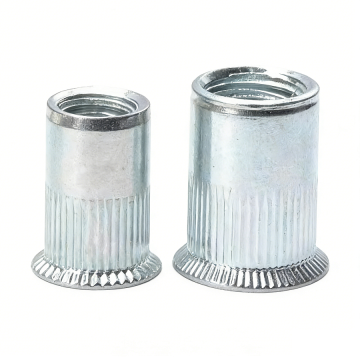
Engineering Breakthrough: Stainless steel rivet nuts provide a permanent, cold-formed internal thread in closed tubular sections or ultra-thin vehicle paneling, yielding high pull-out resistance and permanent anti-rotation locking without welding heat damage.
During pneumatic-hydraulic or battery-powered tool upsetting, the stainless steel rivet nut collapses uniformly into a calibrated backside bulb while radially expanding into the parent panel. Under-head serrations and knurled body ribs embed into the metal matrix, preventing torque-out caused by engine rumble and dynamic chassis twists.
As vehicle design migrates toward aluminum die-cast housings, carbon-composite battery trays, and ultra-high-strength steel (UHSS), thermal expansion differentials exacerbate dynamic loosening. Stainless steel blind rivet nuts bridge dissimilar galvanic pairs with custom anti-corrosive passivation coatings and high thermal fatigue life.
Selecting the ideal stainless grade is paramount to balancing cold workability, thread yield limits, and environmental survivability against salt-spray deicers and cyclical load fatigue.
| Alloy Grade | Tensile Strength (MPa) | Yield Strength (MPa) | Corrosion / Salt-Spray Rating | Primary Automotive Deployment Zone |
|---|---|---|---|---|
| AISI 304 (A2-70) | 700 – 850 | 450 – 600 | 1,000+ Hours (ASTM B117) | Body-in-White brackets, internal cockpit reinforcements, battery crossmember bracing. |
| AISI 316 (A4-80) | 800 – 950 | 600 – 720 | 2,000+ Hours (Marine/Chloride) | Underbody armor shielding, wheel-well splash assemblies, commercial truck brine exposure. |
| AISI 430 Ferritic | 480 – 600 | 320 – 420 | Medium Resistance | Exhaust heat shields, non-structural cabin trim mounting, decorative trim panels. |
| High-Yield A2 Modified | 850 – 1050 | 700 – 880 | 1,500+ Hours with Sealant | High-vibration EV battery pack closure lids, suspension sensor anchor plates. |
A detailed examination of mechanical lock kinetics under multi-axial cyclic loading, shear stresses, and high-G road shock environments.
In critical automotive suspension nodes, round body rivet nuts can spin out if service bolts are over-torqued or seized. Hexagonal stainless steel rivet nuts installed into punched hex holes provide 100% mechanical interlocking, boosting spin-out torque resistance by over 300% compared to standard knurled fasteners.
Access in closed hydroformed tubes, longitudinal chassis rails, and rocker sills is limited to one single side. The controlled wall thinning in the rivet nut collapse zone initiates a uniform 360-degree retention bulb, distributing clamping stresses broadly over thin-gauge sheets and minimizing sheet metal tearing under vibration.
Unlike machined threads that cut through the metallic grain flow, rolled stainless steel threads undergo strain-hardening during fabrication. This process creates unbroken continuous grain structure along thread roots, maximizing fatigue endurance and preventing thread stripping during high-torque robotic fastener assembly.
Engineered to eliminate NVH (Noise, Vibration, Harshness) and sustain structural clamp loads across every critical vehicle sub-assembly.
Electric vehicle battery assemblies require repeatable hermetic sealing against moisture, dust (IP67/IP69K), and continuous dynamic shaking over rough terrains. Stainless steel rivet nuts paired with elastomer underhead rings guarantee uniform pressure across the perimeter flange, preserving battery enclosure isolation throughout decades of thermal cycling.
Underbody aerodynamic diffusers, sway bar links, and transmission harnesses endure direct bombardment by gravel, road slush, and heavy road vibration. Utilizing anti-vibration stainless rivet nuts ensures that brackets remain firmly seated without galling or thread oxidation, guaranteeing effortless vehicle maintenance over high service mileages.
In municipal transit buses, over-the-road class 8 tractors, and specialized fire apparatus, chassis flexure is continuous and brutal. Blind rivet nuts anchor roof railings, seating pedestal frames, overhead storage compartments, and HVAC ducts directly into thin-walled rectangular tubing without weakening the structural skeleton through thermal welding.
Bridging mechanical reliability with artificial intelligence to achieve zero-defect assembly lines in high-volume automotive production.
As tier-1 automotive suppliers transition to full automation, manual rivet nut setting is rapidly being augmented by multi-axis robot cells. Smart end-effectors equipped with real-time force-displacement transceivers track every micro-millimeter of stroke and every Newton of tensile pulling force.
By comparing dynamic setting curves against AI-calibrated master envelope profiles, the automated assembly station detects sheet thickness anomalies, hole diameter variations, stripped internal threads, or improper fastener seating instantaneously—logging 100% trace data to the plant Manufacturing Execution System (MES).
Advanced factories are currently incorporating acoustic vibration analysis directly into riveting mandrels. When a stainless steel rivet nut collapses, it generates unique ultrasonic emission frequencies. AI models trained on millions of riveting cycles accurately discern cold-work cracking or tool mandrel wear long before assembly defects can migrate down the production corridor.
Result: Comprehensive cycle verification ensures that every single rivet nut installed meets the strict vibration resistance and pull-out specifications demanded by international safety bodies (ISO 26262).
Explore our comprehensive industrial catalog of high-strength, vibration-tested blind rivets and knurled rivet nuts engineered for demanding multi-material joining.