Leave Your Message
Explore primary countersunk and blind threaded solutions optimized for outdoor galvanic integrity and mechanical endurance.
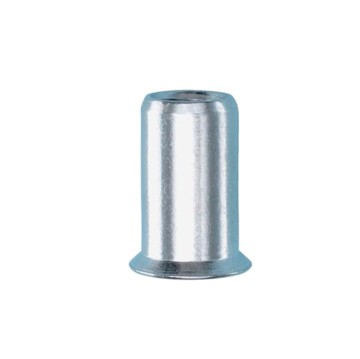
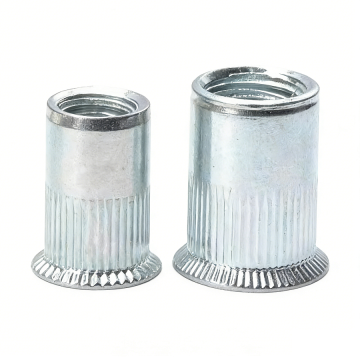
When mechanical joints are exposed to continuous outdoor weathering, two critical failure modes emerge: fluid accumulation at fastener interfaces and aerodynamic or shear turbulence across protruding fastener heads. The countersunk rivet nut (often specified with a 90° or 120° head angle) is designed precisely to eliminate these failure points by establishing a 100% flush interface.
Unlike traditional protruding hex or flat-head blind inserts, a countersunk rivet nut embeds seamlessly into pre-chamfered parent sheets. This flush positioning eliminates the micro-gap where stagnant water, condensation, particulate pollution, and saline mist typically pool. In coastal environments (ISO 12944 category C4 and C5-M), stagnant moisture accumulation catalyzes crevice corrosion, leading to accelerated pitting, thread galling, and unexpected structural failure. By ensuring an uninterrupted surface plane, the countersunk architecture allows wind-driven moisture and surface runoff to shed effortlessly.
The modern industrial landscape is witnessing an aggressive push toward structural dematerialization, lightweighting, and extended service lives exceeding 25 to 30 years without routine maintenance. This evolution heavily impacts hardware selection for outdoor civil infrastructure, renewable generation, and automotive transport.
Utility-scale solar tracking stations and offshore solar arrays demand millions of threaded connections capable of surviving sustained ultraviolet bombardment, cyclic wind turbulence, and ammonia or salt-mist atmospheric degradation. Countersunk rivet nuts provide the structural pull-out strength required without increasing profile drag or interfering with bifacial PV glass clearance.
Automotive body architectures, refrigerated shipping containers, and modern transit coaches increasingly pair carbon fiber reinforced polymers (CFRP) or aluminum alloys with high-strength galvanized steel. Countersunk inserts isolate contact points and prevent galvanic couple formation, safeguarding thin-gauge substrates from interfacial galvanic corrosion.
Manufacturing plants are rapidly transitioning toward AI-vision-guided hydro-pneumatic blind installation cells. Modern countersunk rivet nuts are engineered with tight head chamfer concentricity and automated feed geometry, allowing high-speed robotic spindle tooling to seat fasteners with closed-loop stroke and load validation.
Achieving a durable outdoor joint requires an exact thermodynamic match between the rivet nut alloy, the parent sheet metal, and ambient environmental stressors. A mechanical failure in outdoor installations is almost never purely mechanical; it is overwhelmingly accelerated by chemical degradation at the boundary layer.
| Material / Grade | Protective Coating / Treatment | Neutral Salt Spray (ASTM B117) | Optimal Outdoor Deployment Scenario |
|---|---|---|---|
| Austenitic Stainless Steel (A4 / 316L) | Passivated / Electro-polished | > 2,500 Hours (Red Rust Free) | Marine vessels, splash zones, coastal telecommunications, chemical processing units. |
| Austenitic Stainless Steel (A2 / 304) | Standard Chemical Passivation | > 1,000 Hours (Red Rust Free) | General outdoor enclosures, architectural facade panels, solar mounting arrays. |
| High-Strength Carbon Steel | Zinc-Nickel (Zn-Ni 12-15%) + Cr(VI)-Free Topcoat | > 1,500 Hours (Red Rust Free) | Automotive chassis exterior brackets, agricultural implements, utility trailer bodies. |
| High-Performance Nickel Alloys | Inherent Passive Oxide Film | > 5,000+ Hours Extreme Acid/Saline | Offshore platform substructures, marine desalinization, heavy industrial exhaust. |
When installing stainless steel countersunk rivet nuts into aluminum alloys (e.g., 6061-T6 or 5052-H32 sheets in outdoor signage or solar framing), engineers must manage the electrochemical potential difference between the two metals. Without protective measures, the higher noble potential of the stainless steel can induce micro-galvanic oxidation of the aluminum parent frame immediately around the countersunk pocket.
To counteract this, industry leaders employ specialized micro-encapsulated organic sealants, engineered cadmium-free sacrificial barrier coatings, or non-conductive dielectric isolation washers underneath the mating bolt. Additionally, choosing knurled or full-hex bodies prevents microscopic torsional play during high-torque tightening, maintaining the physical integrity of the protective surface treatment across decades of service.
On pleasure craft, commercial naval vessels, and offshore oil platforms, deck gear, cleats, and sensor arrays require frequent maintenance and structural replacement. Welded nuts present fire hazards on existing hulls and produce weld-seam oxidation points. Marine-grade A4/316 countersunk rivet nuts allow single-sided blind fastening directly into tubular railings and composite sandwich deck bulkheads, providing a smooth walking surface free of trip hazards.
High-rise ventilated rainscreens utilize thin architectural stone, terracotta, or anodized aluminum composite panels (ACP). Fastener heads cannot project beyond the panel sub-framing without disrupting insulation blankets and panel articulation. Countersunk rivet nuts provide the required load-bearing capacity for seismic and cyclonic wind conditions while maintaining a completely flush sub-frame profile.
Mounted at the summits of communication towers in high-humidity and industrial smog zones, telecom base stations experience severe diurnal thermal cycling (−40°C to +85°C). Countersunk rivet nuts maintain clamped preload despite thermal expansion disparities, preventing water penetration into sensitive electronics enclosures and resisting wind-induced vibrational loosening.
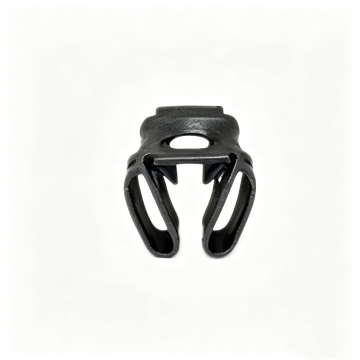
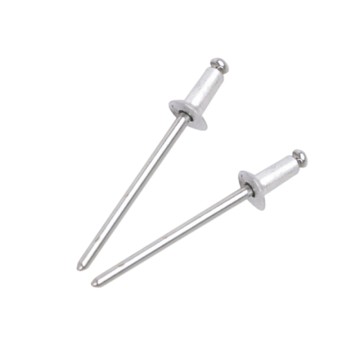
Lantern rivets are often used to connect components such as plastic instrument panels, interior trim panels and automotive interior decorations. These parts are mostly made of fragile or soft materials like plastics. The three folded feet formed after the riveting of lantern rivets can distribute the clamping force, avoiding damage to the riveted materials. Meanwhile, rivets with large caps can increase the riveting area and further disperse the riveting load.
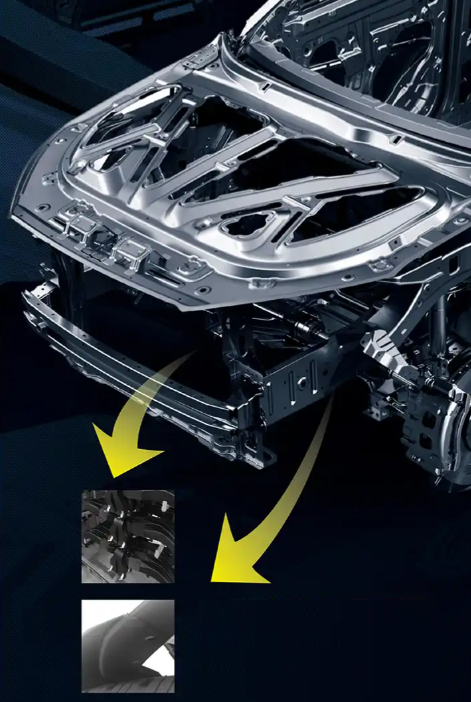
Lantern rivets are extensively applied in the assembly of automotive bumpers. They have good load - bearing capacity and stability, are suitable for connecting various metal and non - metal materials, and can meet the requirements of reinforced assembly between bumpers and vehicle body structures. In addition, lantern rivets are also used for fixing some automotive lamps, and their structure can provide reliable connection in vibrating environments.
In the automotive ventilation system, lantern rivets can be used to connect related components. The components of the ventilation system usually need to be connected with materials such as rubber and plastics, and the characteristics of lantern rivets make them well - adapted to these materials, ensuring the firmness and tightness of the connection.
Lantern rivets are also adopted for connecting the casings or brackets of electronic equipment inside the car, such as audio systems and on - board computers. They can realize the reliable connection of components like thin metal plates or plastic casings without damaging electronic components.
For some trucks or cars equipped with tarpaulins, lantern - type rivet nuts can be used to fix the tarpaulins. Their expanded structure has a large contact surface, which can fix the tarpaulins more firmly.
Achieving the full shear strength and moisture-sealing capability of a countersunk rivet nut requires strict adherence to sheet preparation and tooling parameters. Any misalignment during setting risks reducing pull-out resistance or causing localized parent metal distortion.
The countersink angle of the parent material must match the head profile of the rivet nut (typically 90° ± 1°). Over-countersinking causes the fastener to sit too deep, concentrating clamping loads onto the edge of the hole rather than the full under-head area. Under-countersinking leaves the head proud, reinstating the water trap and destroying flush planar geometry.
Rivet nuts feature clearly defined minimum and maximum grip limits. Installing an insert into sheet stacks thinner than the specified minimum results in incomplete bulb formation on the blind side, inducing thread tilt and premature looseness under vibration. Stacks that exceed the maximum limit prevent the rear collar from fully upsetting, risking spin-out during bolt torqueing.
Modern pneumatic-hydraulic and battery-powered installation tools offer two primary operating modes: stroke-controlled and pull-force-controlled. For countersunk rivet nuts in variable-gauge outdoor framing, pull-force control is superior. It ensures that the fastener achieves optimal clamping force regardless of slight variations in sheet thickness, avoiding thread stripping or under-setting.
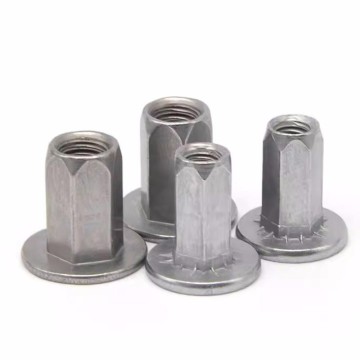
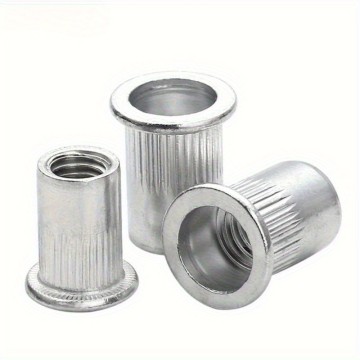
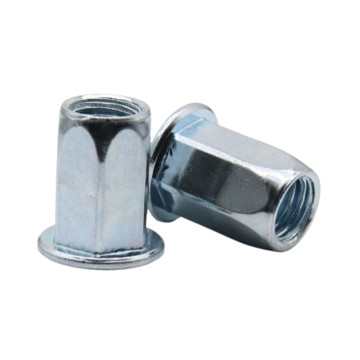
While smooth-body countersunk nuts are suitable for light assemblies, outdoor environments subjected to dynamic loads (e.g., wind buffeting on panels, vehicular chassis vibrations) benefit substantially from knurled or full-hex bodies. Hexagonal profiles completely eliminate spin-out risks during bolt installation and subsequent field disassembly, ensuring maintenance without frame damage.
Select from our complete range of certified corrosion-resistant rivet nuts, expansion inserts, and countersunk blind rivets engineered for aerospace, industrial, marine, and automotive durability.