Leave Your Message
0%

Sure, automotive rivets are tiny little parts, but don’t underestimate them. They can make or break assembly speed, how consistent those joints are, and even how long a vehicle holds up over the years. To put the demand into perspective: OICA says roughly 93.5 million vehicles were built worldwide in 2023 — that’s a whole lot of fasteners needing to do their job. And with the IEA’s Global EV Outlook 2024 showing close to 14 million electric cars sold in 2023, about 18% of all new car sales, the pressure’s on for fastening solutions that keep up with both traditional and EV production. Honestly, all these shifts are putting real pressure on the design side. You've got lightweight materials, mixed-material structures, and production requirements that are way tighter than before.

So, here’s a guide I put together on China’s top 10 automotive aluminium rivet suppliers. I looked at their product range, how much manufacturing experience they have, their quality practices, and—most importantly—whether they’re actually suitable for automotive applications. It also looks at aluminium tri-fold blind rivets for automotive—they offer broad bearing contact when you're joining thin or softer materials. And for jobs that need a wider flange, there's the Aluminium Large Flange Tri-Fold Blind Rivets. Small parts matter, don't they? But honestly, supplier claims and public specs don't always reflect how consistent things are in the real world. Honestly, if you're a buyer, don't just take the spec sheet at face value. Check the material grades, tolerances, test reports—and ideally run some samples through your own assembly line. That comparison gives you a baseline, but it's only a start. It's not a replacement for real technical validation. Suppliers change, processes drift, and a shiny catalog can hide a lot. So yeah, trust but verify.

China Top 10 Automotive Aluminium Rivet Suppliers

Automotive Aluminium Rivets: Types, Materials, and Key Functions

Automotive aluminium rivets join lightweight panels where welding may distort thin sheet or complicate mixed-material assemblies. Common options include solid rivets for accessible, high-load joints; blind rivets for one-sided installation; and self-piercing rivets for overlapping sheets. Tri-fold blind rivets aluminium are useful when a broad rear-side grip is needed, such as fastening trim or components to hollow sections. Their legs open behind the panel. Fit matters.

Rivet bodies may use aluminium alloys selected for formability and strength, while mandrels can use other metals. Check material compatibility, hole size, grip range, and vibration loads; a poor match can loosen or accelerate corrosion.

The 2020 DuckerFrontier North American Light Vehicle Aluminum Content and Outlook report projected average aluminium content rising from 397 pounds per vehicle in 2015 to 514 pounds by 2026.

That trend makes repeatable joining important, but it does not mean every joint should use aluminium rivets. Not always. For each assembly, engineers should validate clamp force and pull-out performance using representative panel thicknesses. A practical test can expose issues that a catalog specification misses.

The Role of Rivets in China's Automotive Manufacturing Supply Chain

China’s automotive supply chain depends on small components that arrive consistently and fit the assembly process. Rivets help join brackets, trim, and selected body components where a fast, repeatable mechanical connection is needed. Aluminium rivets can reduce component weight, but their suitability depends on joint design, material thickness, and service conditions. A lightweight fastener is not automatically the right fastener.

For suppliers, reliable delivery matters as much as the rivet itself. Automotive plants need stable dimensions, controlled batches, and clear inspection records. Checks may include rivet diameter, grip range, setting performance, and mandrel retention. These details help reduce assembly stoppages and rework. Still, a neat sample can mislead. Production trials reveal issues that a bench test may miss, such as access limits or inconsistent tool settings. Products such as aluminium tri-fold rivets may suit certain joints, but engineers should confirm performance against the actual application.

Tips: Share drawings, material thickness, and expected installation volume before requesting samples. Ask how batches are identified and how dimensional changes are communicated. Test fasteners on the intended equipment, not only by hand. Small gaps in communication can become costly production delays.

Criteria for Identifying China's Top Automotive Aluminium Rivet Suppliers

Choosing an automotive aluminium rivet supplier requires more than comparing unit prices. Start with material traceability: request alloy and temper records linked to production batches. Ask for evidence. Useful checks include shank diameter, head dimensions, shear performance, and consistency across sampled lots. Suppliers should explain inspection methods and show how they handle out-of-spec results. Paperwork matters. Still, a certificate alone cannot reveal how a production line performs during a busy shift. Review process controls, calibration schedules, defect records, and change-notification practices. When practical, arrange a site visit or structured remote audit. Look at actual gauges and sample parts, not just presentation slides.

Compare claimed capacity with equipment, staffing, lead times, and contingency plans. Request samples made with the proposed production process, then check fit and installation behavior under realistic conditions. Small details count. Clear communication about tolerances, packaging, and delivery updates can prevent avoidable delays. Ask who handles technical questions and how quickly issues are escalated. A capable supplier may still have gaps; note them rather than smoothing them over. No checklist catches everything. A controlled trial order can reveal differences between promised quality and routine output before larger orders begin.

China Automotive Aluminium Rivet Supplier Evaluation Criteria

Suggested weighting for a 100-point supplier-screening framework. These are evaluation criteria, not verified supplier scores or a market ranking.

Assess quality systems, engineering capability, material traceability, delivery capacity, and compliance using documented evidence such as audits, test records, and production data.

Profiles of Ten Leading Chinese Automotive Aluminium Rivet Suppliers

The ten supplier profiles are best compared by production strengths, not by an assumed ranking. One profile focuses on aluminium extrusion and rivet forming under one roof. Another specializes in cold heading for consistent shank dimensions. A third offers CNC finishing for tight assembly tolerances. A fourth emphasizes drawing-based customization. Look for clear process descriptions and sample inspection records.

Other profiles may stand out for corrosion-resistant surface treatment, high-volume output, flexible small batches, export-ready packing, or application engineering. A supplier with strong tooling support can help refine rivet length and head shape. One with traceable inspection steps may provide steadier quality between batches. These are useful distinctions, though a polished catalogue alone proves little. Confirm capacity and specifications directly.

Tips: Request samples, material details, dimensional reports, and a trial-order plan. Check that the rivet fits your joining method and sheet thickness. A small mismatch can matter.

Comparing Supplier Products, Capabilities, and Quality Certifications

Comparing China’s automotive aluminium rivet suppliers takes more than checking catalogue prices. Product ranges may include open-end, sealed, structural, and All Aluminum Tri-Fold Blind Rivets. These designs serve different joint conditions. Match rivet body material, mandrel design, grip range, and head style to the actual panel stack. A useful supplier can provide dimensional drawings and test data, not just a product photo.

Manufacturing capability matters on the shop floor. Ask about forming consistency, surface treatment, automated inspection, and lot traceability. For a trial, check setting force, mandrel break, hole fit, and joint strength on representative coated panels. Small differences in grip length can cause loose joints or panel distortion. Fit matters. Compare samples from several production lots before approving a source.

Quality certifications help assess process control, but a certificate alone does not prove that a specific rivet meets your application needs. Request current certificates, scope details, inspection records, and material documentation. Confirm how the supplier handles nonconforming parts and corrective actions. Claims should be verifiable. One comparison can still miss real production variation, so retain samples and review performance after line trials.

China Top 10 Automotive Aluminium Rivet Suppliers - Comparing Supplier Products, Capabilities, and Quality Certifications

Data note: No supplier-specific source data was provided. The ten entries below are anonymized comparison profiles, not verified company rankings or claims about identifiable manufacturers. Product ranges are indicative industry examples; certification status is marked as unverified and should be confirmed directly with each supplier.

Anonymous Profile Representative Aluminium Rivet Products Typical Product / Capability Scope Automotive Application Fit Quality & Certification Check Key Evaluation Point
Supplier Profile 01
Blind-rivet focused
Open-end aluminium blind rivets; aluminium body with steel mandrel options Common blind-rivet diameters include approximately 3.2–6.4 mm; grip range depends on the specific part design. Suitable for joining accessible-from-one-side sheet assemblies, subject to joint-load and corrosion testing. Supplier-specific ISO 9001 or IATF 16949 status: not verified. Request current certificates and scope. Check grip-range coverage, mandrel retention, setting force, and joint strength test data.
Supplier Profile 02
Structural-rivet focused
High-strength structural blind rivets with aluminium alloy bodies Structural designs use a mechanically retained mandrel or other locking feature; performance is design-specific. Potential fit for higher-load body and component joints only after engineering validation. Supplier-specific certification: not verified. Ask for process controls and product validation records. Review shear and tensile results, hole-size requirements, installation window, and mandrel-lock consistency.
Supplier Profile 03
Large-diameter range
Large-diameter blind rivets and application-specific aluminium fasteners Some blind-rivet catalogs extend to about 6.4 mm diameter; larger or special sizes require drawing confirmation. May serve thicker stack-ups or larger fastening points when the joint design and tool capacity permit. Supplier-specific certification: not verified. Verify certificate validity and manufacturing-site coverage. Confirm total grip range, head style, hole tolerance, and compatibility with the specified setting tool.
Supplier Profile 04
Custom-drawing capability
Made-to-drawing aluminium rivets; custom head, body, or mandrel configurations Custom dimensions and tolerances are defined by the approved drawing and control plan, not by a generic catalog range. Useful where packaging, access, or joint geometry calls for a non-standard fastener. Supplier-specific certification: not verified. Request drawing-change control and first-article documentation. Check tooling ownership, engineering-change procedures, sample approval, and production capability evidence.
Supplier Profile 05
Aluminium-alloy options
Rivets using aluminium alloy bodies; alloy and temper specified by product Alloy selection affects strength, forming behavior, and corrosion performance; confirm the exact alloy and temper by material certificate. Potentially suitable for weight-sensitive assemblies when strength and galvanic-corrosion needs are addressed. Supplier-specific certification: not verified. Request material traceability and incoming-material controls. Confirm alloy designation, temper, mechanical properties, and compatibility with adjoining materials.
Supplier Profile 06
Surface-treatment options
Aluminium rivets supplied with specified finish or conversion treatment, where offered Finish availability and performance depend on the process specification; do not assume a treatment from appearance alone. Can be considered for assemblies with defined appearance or environmental requirements after compatibility testing. Supplier-specific certification: not verified. Obtain the finish specification and test reports for the actual part. Assess corrosion exposure, coating thickness or conversion requirements, and contact with dissimilar metals.
Supplier Profile 07
Blind-side installation
Standard and sealed-head blind-rivet designs, subject to supplier range Blind rivets can be installed from one side; sealed variants are design-specific and do not automatically provide a qualified watertight joint. Potential fit for closed sections or assemblies with restricted rear access. Supplier-specific certification: not verified. Request application-specific leakage and durability results when sealing matters. Validate access, hole preparation, setting-tool nosepiece, and any required leak or environmental test.
Supplier Profile 08
High-volume production
Catalog aluminium blind rivets supplied for repeat production Production suitability depends on demonstrated capacity, inspection plans, lot control, and delivery performance. May suit recurring assembly programs after production trials and customer approval. Supplier-specific ISO 9001 or IATF 16949 status: not verified. Verify certificate number, scope, site, and expiry. Review process capability, lot traceability, control plan, change notification, and continuity planning.
Supplier Profile 09
Special-packaging capability
Standard or custom-configured rivets with packaging options Bulk, counted, or line-side packaging may be available; packaging and labeling requirements need written confirmation. Potential fit for automated feeding or controlled assembly logistics when validated with the production equipment. Supplier-specific certification: not verified. Confirm packaging controls and product-identification traceability. Trial the actual package on the line; check feed reliability, contamination controls, and label data.
Supplier Profile 10
Engineering-support focused
Application-selected blind rivets and related technical support Selection should be based on joint stack-up, load case, material combination, access, and installation equipment. Potential fit for programs needing joint-design review or fastener validation support. Supplier-specific certification: not verified. Request documented quality-system evidence and relevant test reports. Ask for a documented recommendation, test method, acceptance criteria, and validation on representative assemblies.

Certification reminder: ISO 9001 and IATF 16949 are quality-management-system standards; they do not by themselves certify an individual rivet or prove that it is suitable for a particular vehicle application. Confirm the certificate’s validity, issuing body, manufacturing-site scope, product specifications, and required customer approvals before sourcing.

How to Evaluate and Select a Chinese Aluminium Rivet Supplier

A supplier should explain how each aluminium rivet fits the joint, not just quote a low unit price. Ask for alloy and temper details, head dimensions, grip range, and documented shear or tensile test results. Check whether the stated values apply to your actual material stack. Small differences matter.

For thin or uneven panels, TRI-FOLD BLIND RIVETS may spread the load across a wider rear surface, but confirm fit with samples. Test them in the real stack-up, including coatings and hole tolerances; catalog images cannot reveal loose setting or panel distortion. Ask how batches are traced and how inspection records connect to lot numbers. Request samples from routine production, not only hand-finished prototypes. That distinction matters.

Review production controls, dimensional inspection frequency, packaging, lead times, and procedures for handling nonconforming parts. Clear answers should include a technical contact and realistic corrective-action timelines. Arrange an audit when order volume justifies it; remote documents alone leave gaps. Compare communication during a small trial order, too. Not glamorous, but useful. A supplier may have sound controls yet little experience with your exact joint, so validation still matters.

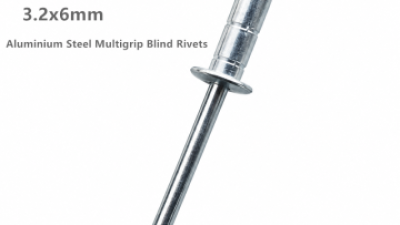
3.2×6 Aluminium Steel Multigrip Blind Rivets: Insights from Grand View Research’s Fastener Market Report

Fastener market analysis highlights the continued importance of dependable, easy-to-install joining solutions across automotive, construction, and industrial assembly. As manufacturers seek to improve productivity while managing material use and assembly time, blind rivets remain a practical choice where access is available from only one side. Demand is also shaped by the need for versatile fastening options that can accommodate differences in material thickness and support consistent installation across varied applications.

The 3.2×6 mm aluminium-steel multigrip blind rivet reflects these priorities in a compact format. During installation, it forms a grip structure on the blind side, helping create a firm connection, while its flexible grip range makes it suitable for assemblies with varying thicknesses. The aluminium-and-steel construction combines a lightweight rivet body with a steel mandrel, and the straightforward setting process can support efficient production and maintenance work. For buyers evaluating fasteners, matching rivet size and grip range to the materials being joined is essential to achieving reliable performance in automotive, construction, and general industrial applications.

FAQS

What records should an automotive aluminium rivet supplier provide?

Request alloy and temper records linked to production batches. Paperwork helps. It isn't proof of consistent production.

Which rivet dimensions and performance details should buyers check?

Check shank diameter, head dimensions, and shear performance. Compare several samples or lots, not just one part.

How can a buyer assess a supplier’s quality controls?

Ask about inspection methods, equipment calibration, defect records, and responses to out-of-spec results. Look for actual gauges and sample parts.

Is a certificate enough to confirm supplier quality?

No. A certificate cannot show how a production line performs during a busy shift. Review process controls, too.

What should a site visit or remote audit include?

Check production equipment, inspection tools, and sample parts. Ask how process changes are reported. Slides alone reveal little.

How should buyers verify production capacity and delivery readiness?

Compare stated capacity with equipment, staffing, lead times, and backup plans. Request clear delivery updates and packaging details.

Why request samples made with the proposed production process?

They help test fit and installation under realistic conditions. Check rivet length and head shape against the joining method and sheet thickness.

Can a small trial order reduce sourcing risks?

Yes. It can reveal differences between promised quality and routine output. A checklist still misses things, so record any gaps before scaling up.

Conclusion

This article examines the role of automotive aluminium rivets in vehicle production, from their common types and material properties to their functions in joining lightweight components. It explains how rivets support China’s automotive manufacturing supply chain and why product consistency, suitable applications, production capacity, and dependable quality control matter to vehicle makers and component buyers. Special attention is given to Aluminium Tri-Fold Blind Rivets For Automotive, including the kinds of fastening needs they may address.

The guide also outlines practical criteria for identifying and comparing Chinese suppliers, such as product range, manufacturing capabilities, testing procedures, and relevant quality certifications. Profiles of ten leading suppliers are presented to help readers understand the range of options available without relying on a single selection factor. The final section offers a structured approach to evaluating suppliers and choosing one that fits an organization’s technical requirements, order volumes, communication needs, and long-term sourcing objectives.

Lila

Lila

Lila is a dedicated marketing professional with extensive experience in the fastener industry, specializing in blind rivets, rivet nuts, and non-standard fasteners. With a profound understanding of the technical aspects and applications of products such as open-end blind rivets, grip blind rivets,......
Previous 7 Tips for Choosing an Aluminium Tri Fold Blind Rivets OEM