
Leave Your Message
Explore our top-tier blind fasteners optimized for specialized mechanical applications across delicate assemblies, composite structural joining, and high-tensile architectural frames.
In modern industrial assembly, the transition from conventional steel and heavy alloys toward lightweight substrates—such as carbon-fiber-reinforced polymers (CFRP), glass-reinforced plastics (GRP), rigid polyurethane foams, polycarbonates, thin sheet aluminum, and laminated composite panels—has fundamentally disrupted fastening engineering. Traditional standard blind rivets rely on radial expansion and high-force concentrated bulbing. When applied to delicate matrices, this localized radial compression regularly results in radial micro-fracturing, surface crazing, substrate delamination, or complete mechanical pull-through.
Aluminum Trifold Rivets (commonly identified as Lantern Rivets, Bulb Rivets, or Tri-Bulb Rivets) solve this fundamental physics barrier. During the setting sequence, the precision-slotted rivet body collapses into three large, wide-spanning folding wings. Rather than exerting localized point-load forces, the trifold structure forms a generous secondary blind-side footprint that effectively disperses clamping forces over a surface area up to 300% wider than standard rivets. This broad load-bearing distribution prevents tensile stress concentration, securely clamping brittle polymers, expanded composite cores, and pliable elastomers without crushing or rupturing their baseline structure.
Three wide wings unfold during mandrell retraction, distributing clamping loads evenly across the surface to protect sensitive, soft, or brittle materials from localized deformation.
The expanded trifold blind footprint easily bridges oversized, misaligned, or oval punched holes, delivering fail-safe clamping even under dynamic vibrations.
Manufactured from refined 5050/5052 grade aluminum alloys, offering superior corrosion resistance and matching thermal expansion characteristics for plastic and composite joints.
Under finite element analysis (FEA), a standard 4.8mm blind rivet concentrates clamping pressure across an annular area of approximately 35 mm², resulting in severe localized peak stress. An Aluminum Trifold Rivet of identical diameter spreads that exact clamp energy across three folded lobes exceeding 125 mm², cutting localized substrate pressure by roughly 70%. This mechanical behavior is the decisive factor that completely eliminates edge chipping in brittle acrylics and prevents extrusion in soft PVC or EPDM layers.
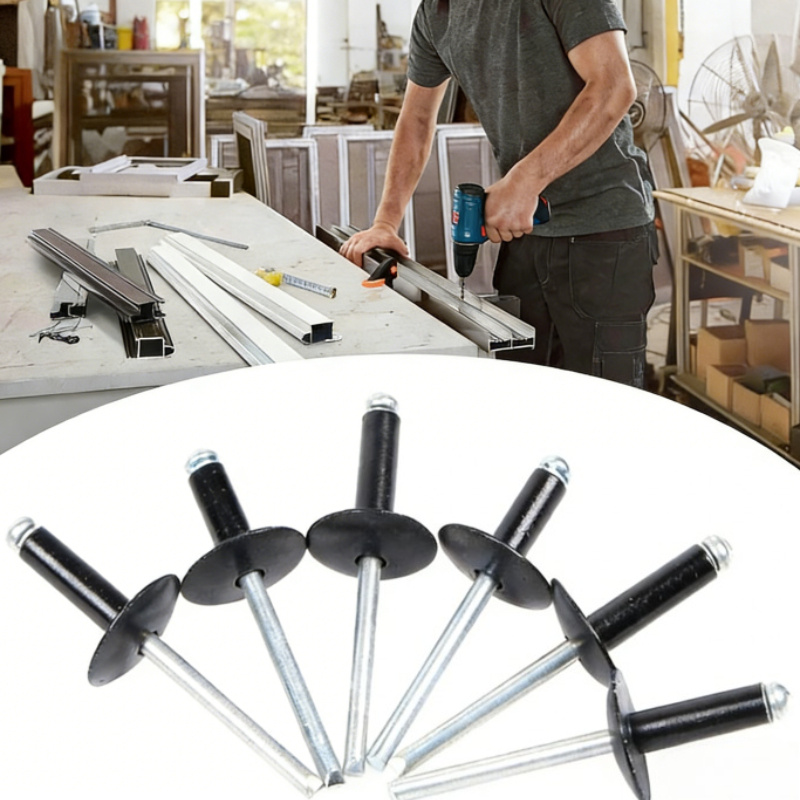

The global transition toward electrification, modular construction, and energy-efficient building skins has created severe mechanical challenges for fastener engineers. Trifold rivets have moved beyond auxiliary hardware into mission-critical structural components across several cutting-edge verticals:
Modern EV skateboard architectures extensively employ Sheet Molding Compound (SMC), carbon-fiber crossbeams, and glass-mat thermoplastics for undertray shields and high-voltage battery enclosures. These materials are notoriously vulnerable to cracking during riveting. Aluminum trifold rivets with integrated EPDM neoprene washers deliver twin advantages: their high-bearing trifold lobes clamp SMC without delamination, while the resilient washer compresses to create an IP67-rated barrier against dust and moisture ingress, preventing corrosive battery pack degradation.
Solar assemblies demand enduring outdoor resistance coupled with the capability to fasten thin-walled extruded aluminum frames to fragile crystalline photovoltaic backing sheets and fiber-composite brackets. High wind loads exert repeated cyclical tensile stress. Standard rivets frequently pull out of thin gauge sheet metal under high shear and gust conditions. The tri-fold wings lock the joint with wide-spread clamping force that absorbs cyclical dynamic fatigue without elongating the drilled pilot holes.
Aluminum Composite Panels (ACP) and multi-wall polycarbonate skylights expand and contract substantially under diurnal thermal cycling. Rigid mechanical fasteners that indent or bind composite facings inevitably cause oil-canning (surface wrinkling) or brittle fractures at mounting corners. Aluminum trifold rivets provide high clamping integrity with gentle residual surface stress, allowing micro-flexibility without risking mechanical failure or cracking under heavy thermal gradients.
| Rivet Classification | Blind-Side Footprint | Stress Concentration | Compatibility with Soft/Brittle Materials | Oversized Hole Accommodation |
|---|---|---|---|---|
| Aluminum Trifold / Lantern Rivet | Wide 3-Fold Spread (Up to 3x Body Ø) | Ultra-Low (Uniform radial distribution) | Exceptional (No cracking, zero pull-through) | Superior (Self-centering & wide bearing) |
| Standard Open-End Blind Rivet | Compact Ball Formation (~1.3x Body Ø) | Very High (Direct localized point pressure) | Poor (High risk of crazing and cratering) | Low (Risk of slipping into oversized hole) |
| Multigrip Blind Rivet | Stepped Radial Bulbing (~1.5x Body Ø) | Moderate to High | Fair (Applicable for pliable plastics only) | Moderate |
| Structural Hemlock Blind Rivet | Heavy Solid Flange (~1.6x Body Ø) | Extremely High (Engineered for heavy steel) | Unsuitable (Causes immediate brittle failure) | High Shear Only |
Achieving zero-defect fastening in fragile assemblies requires meticulous attention to pilot hole tolerances, mandrel pulling speeds, and grip length selection. Below are essential engineering guidelines developed to maximize joint performance when deploying aluminum trifold fasteners:
Maintain drilled hole diameters within +0.2mm to +0.3mm of nominal rivet diameter. Even though trifold wings cover oversized apertures, tight initial tolerances prevent shear shifting during high dynamic vibration.
Calibrate setting tool pneumatic/hydraulic pull pressures to prevent shock impact. Smooth stroke retraction ensures the aluminum body fractures along prefabricated slit paths uniformly without sudden impact shock to brittle polymers.
For external architectural panels or marine equipment, specify trifold rivets equipped with pre-assembled vulcanized EPDM washers. The controlled setting force seals the aperture without squeezing out or tearing the elastomer ring.
Alloy Selection Considerations: The rivet body is typically formed from high-purity aluminum alloys (e.g., AlMg 2.5 / AA 5052 or AlMg 3.5 / AA 5154). These alloys provide an optimal balance of malleability—allowing the slotted body to fold cleanly without localized work-hardening fractures—and shear strength to withstand operational payloads. Mandrels are crafted from specialized aluminum alloys or coated phosphate steel, ensuring clean snap breaks flush with or beneath the primary rivet head.
From ultra-long blind fasteners and multigrip blind rivets to heavy structural hemlocks and specialized countersunk configurations, examine our comprehensive catalog engineered for precision assembly.
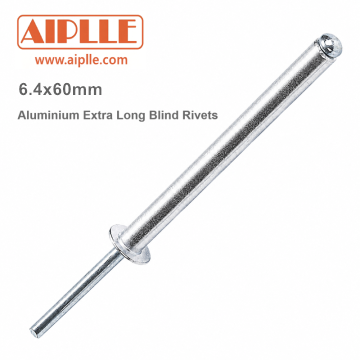 6.4x60 Aluminium Extra Long Blind Rivets
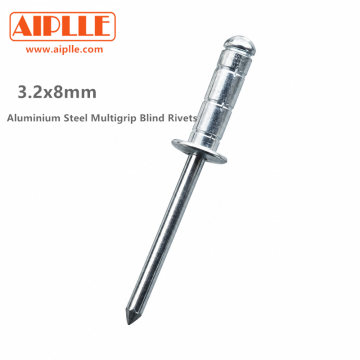 3.2x8 Aluminium Steel Multigrip Blind Rivets
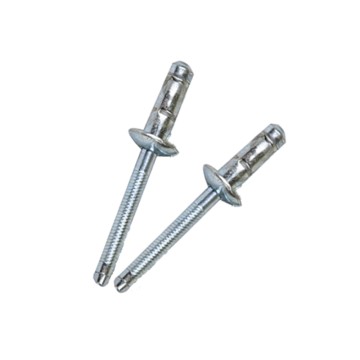 Steel Hemlock Blind Rivets
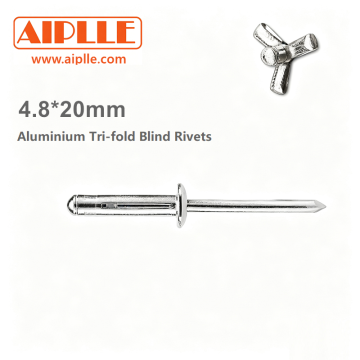 4.8x20 Aluminium Tri-fold Blind Rivets
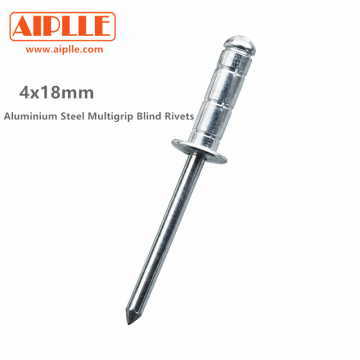 4x18 Aluminium Steel Multigrip Blind Rivets
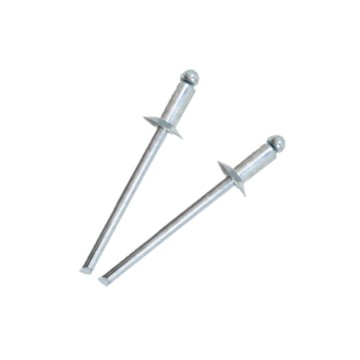 Steel Countersunk Head Blind Rivets
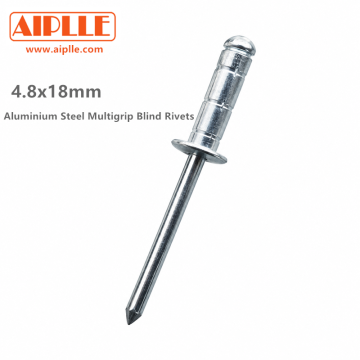 4.8x18 Aluminium Steel Multigrip Blind Rivets
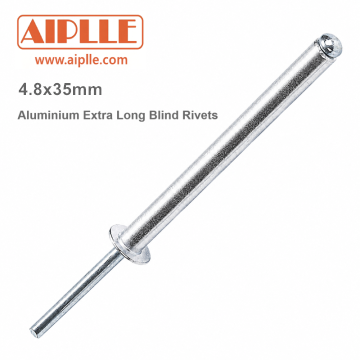 4.8x35 Aluminium Extra Long Blind Rivets
Standard rivets rely on back-side expansion that compresses radially inward and slightly outward. In foam cores or soft honeycombs, this simply caves in the substrate, pulling the head completely through the material. Trifold rivets collapse outward into three long structural petals. These petals span widely across the inner structural skin of the panel, creating a vast anchor plate that bridges the foam matrix and establishes permanent mechanical capture.
Yes. Aluminum trifold rivets are fully compatible with bowl-fed and tape-collated automated riveting installations. Because automated lines demand consistent mandrel break loads to avoid robotic tool stalling, our trifold mandrels feature CNC-machined break notches that ensure precise rupture thresholds within +/- 5% tolerance, ensuring uninterrupted mass-production cycles.
Forming the delicate three-wing lantern shape requires an alloy with exceptional ductility and uniform elongation. High-grade aluminum alloys fold cleanly along pre-cut longitudinal slots without fracturing at the apex. Furthermore, the lighter setting load of aluminum ensures the clamp force ceases before reaching the compressive yield point of delicate plastics, acrylics, and fiber-reinforced laminates.