Leave Your Message
Ultra-lightweight, high-tensile blind structural rivet solutions engineered for critical aviation airframes and secondary assemblies.
Addressing modern payload optimization, fuel efficiency, and composite integration across global commercial aviation and defense sectors.
The aerospace manufacturing landscape is undergoing a systemic paradigm shift toward decarbonization, maximized payload range, and extended flight efficiency. Central to this transition is structural lightweighting. High-strength aluminum rivets serve as the unsung champions of modern aerodynamic structural design. While modern aircraft airframes leverage massive amounts of carbon-fiber reinforced polymers (CFRP) and honeycomb aluminum matrices, mechanical fasteners remain the decisive elements providing fail-safe joint redundancy and high shear-tensile durability.
Utilizing high-grade aerospace aluminum alloys—specifically 2000-series (copper-alloyed), 7000-series (zinc-alloyed), and modern aluminum-lithium formulations—blind rivets provide an optimal strength-to-weight ratio without introducing the parasitic mass associated with conventional heavy steel bolting systems.
Unlike standard industrial fasteners, aluminum rivets deployed in aerospace applications must withstand cyclic cabin pressurization, severe aerodynamic drag forces, multi-axial vibrations, and thermal variations ranging from -55°C at cruising altitudes to over +85°C on desert runways. The technological evolution has fostered precision cold-heading processes and specialized surface conversion coatings such as chromate-free chemical films and anodization.
These surface enhancements prevent microscopic galvanic corrosion when aluminum fasteners sit in direct contact with carbon composite structures or specialized titanium-bearing airframe spars, ensuring predictable performance lifecycles across thousands of flight cycles.
Engineered with tailored thermal expansion coefficients matching modern hybrid aluminum-composite skin alloys, minimizing micro-gap formation under extreme altitude temperature deltas.
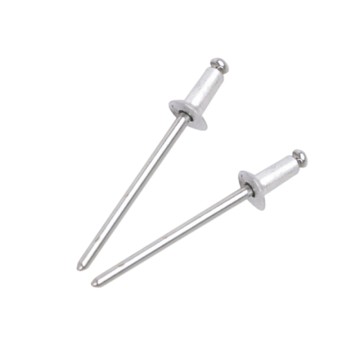
Optimized for single-sided installation in confined airframe cavities, nacelles, and leading edges, dramatically reducing manufacturing man-hours and enabling automated robotic tooling integration.
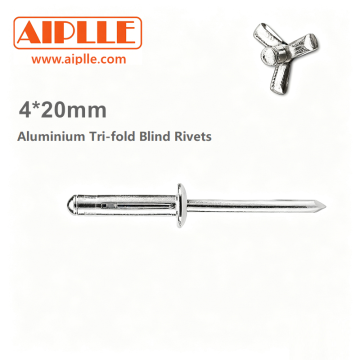
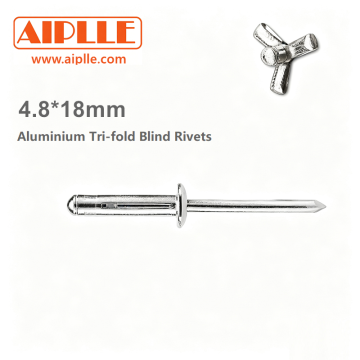
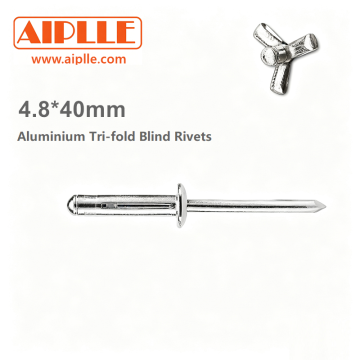
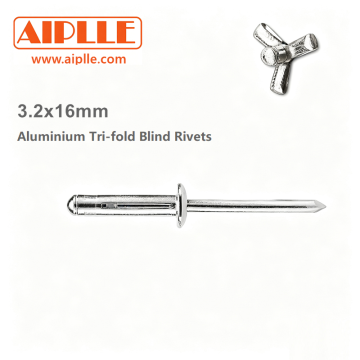
Advanced trifold and bulb configurations establish wide load-bearing footprints on the blind side, dispersing continuous dynamic stress to prevent delamination in thin sheet assemblies.
Exploring specialized structural sectors across airframes, nacelles, cabin architectures, and unmanned aerial systems (UAS).
In modern fuselage interiors, routing complex lightweight titanium, composite, and aluminum ducts for environmental control systems (ECS) demands mechanical fastening that distributes continuous clamping force without cracking thin wall conduits. Tri-fold and lantern-type aluminum blind rivets are uniquely qualified: upon actuation, the body folds into three distinct petals that spread mechanical loads across an expansive surface area, eliminating point-load failures on thin-gauge interior skins.
Cockpit instrument panels, electronic flight bags (EFB) housing mounts, and digital avionics bays demand non-magnetic, corrosion-resistant, and vibration-damped connections. Aluminum countersunk blind rivets deliver aerodynamic flushness alongside electromagnetic compatibility (EMC), preserving vital structural grounding without creating electrostatic interference across mission-critical avionics networks.
Airlines operate under strict operational weight restrictions; every gram saved directly correlates to reduced fuel consumption and lowered carbon emissions. Aluminum blind rivets are employed throughout seating frameworks, overhead stowage bins, modular partition walls, and commercial galley modules. They provide rapid field-service maintenance capability, allowing single-technician repairs from the cabin interior without requiring disassembly of external airframe skins.
The burgeoning electric vertical takeoff and landing (eVTOL) sector is governed by ultra-stringent weight-to-energy ratios. Aluminum rivets provide the ideal micro-fastening solution for lightweight hybrid thermoplastic fuselages, sensor arrays, battery compartment shields, and wing fairings, providing unmatched structural cohesion under high-frequency electric motor vibrations.
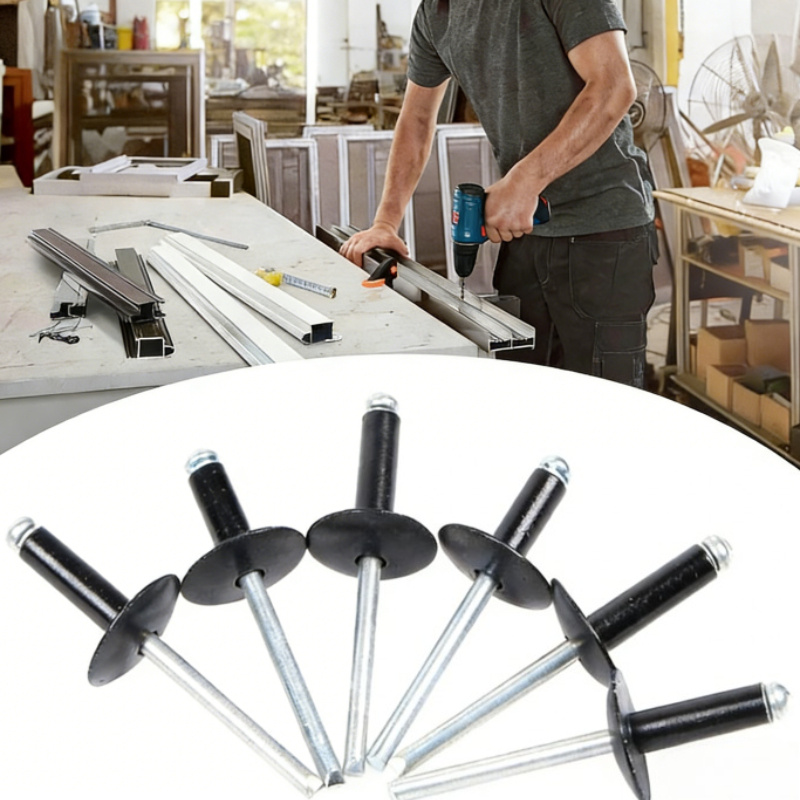

Expanding the high-integrity benefits of lantern, bulb, and trifold riveting systems into global commercial manufacturing sectors.
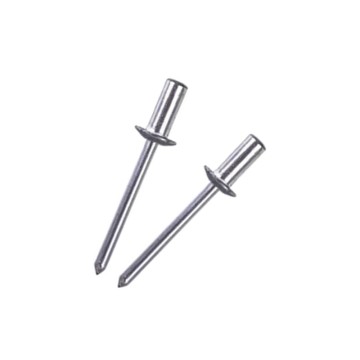
Lantern rivets are one-sided riveting fasteners. After riveting, the rivet head takes on a distinct lantern-like or tri-folded shape. Thanks to their unique load-distributing structure and vibration-proof performance, they are widely utilized across diverse industrial and manufacturing fields:
They can be applied to connect components such as automotive instrument panels and ventilation systems. These parts often adopt fragile or flexible materials like plastics and rubbers. The three-fold legs formed during the riveting process of lantern rivets can distribute the clamping force evenly, preventing damage to the riveted materials.
In the assembly of electronic instruments and devices, lantern rivets are suitable for joining thin metal plates, plastic casings, and other parts. They not only ensure a firm connection but also avoid harming precision electronic components.
They are commonly used in food packaging, wine packaging, and other sectors. Lantern rivets can firmly rivet packaging materials including cartons and plastic sheets. Meanwhile, their aesthetic appearance can enhance the overall texture of the packages.
They are ideal for connecting metal furniture, wooden products, and more. For components with irregular shapes or connection holes of large sizes, lantern rivets perform excellently and guarantee the structural stability of the furniture.
In the assembly of home appliances such as refrigerators and washing machines, lantern rivets can be used to fix casings, internal brackets, and other parts. They feature excellent shock resistance and tensile strength, preventing the loosening of connections during long-term use.
In gift, artwork, and toy industries, lantern rivets not only realize secure fastening but can also be processed into various colors and patterns on the rivet head through baking paint processes, matching aesthetic design criteria.
They are used for connecting door and window accessories as well as fixing architectural decoration panels. For irregular or oversized installation holes, lantern rivets provide reliable, high-integrity connection solutions.
Explore our complete range of blind, tri-fold, closed-end, and extra-long aerospace and industrial grade fasteners.