Leave Your Message
Engineered for unilateral access, thin-gauge sheet security, and fiber-reinforced composite integrity without micro-cracking.
The aerospace manufacturing landscape is undergoing a monumental paradigm shift driven by stringent decarbonization mandates, fuel efficiency imperatives, and the explosive emergence of electric vertical takeoff and landing (eVTOL) aircraft. In modern aeronautical structural design, every gram saved directly translates to increased operational payload, expanded flight range, and drastically lowered carbon emissions.
Traditional structural fastening mechanisms—such as heavy solid rivets, bulky nut-and-bolt assemblies, and complex thermal welding setups—are increasingly untenable for next-generation multi-material assemblies. Modern airframes continuously introduce hybrid sandwich panels, carbon-fiber reinforced plastics (CFRP), honeycomb composite substrates, and aerospace-grade aluminium-lithium (Al-Li) alloys. In enclosed wing boxes, closed-cell stabilizers, fuselage stringers, and complex ductwork where blind-side tool access is physically impossible, high-strength aluminium blind rivets provide the ultimate joining solution.
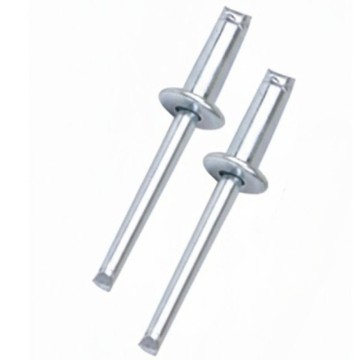
Aerospace-grade aluminium blind fasteners utilize specialized alloys (such as 5056 Al-Mg and 7075 Al-Zn) treated with advanced passivations. This matches the thermal expansion coefficient of parent aluminium airframe structures while preventing galvanic degradation when interacting with moisture and carbon fabrics.
Integrated pneumatic and robotic smart-riveting end effectors achieve cycle times under 1.2 seconds per fastener. Continuous cycle tracking ensures real-time setting load verification and positional accuracy for Industry 4.0 aerospace assembly floors.
How tri-fold geometry and precision mandrel design protect sensitive composite laminates under extreme flight conditions.
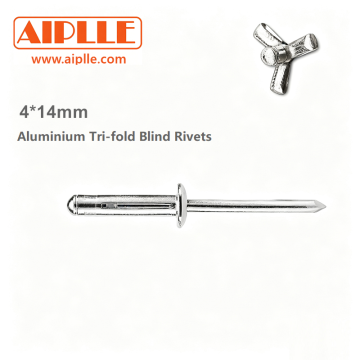
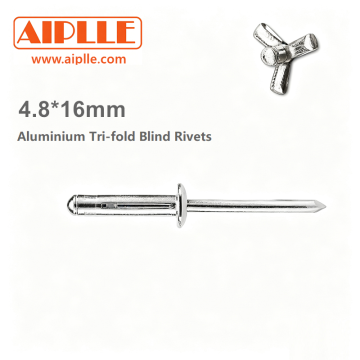
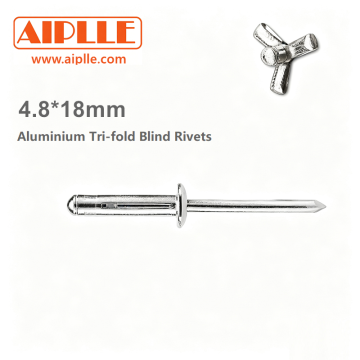
Standard blind rivets collapse into a tight bulb that can exert excessive localized point stress, crushing fragile core materials or delaminating resin matrices. The tri-fold rivet mechanism splits cleanly into three broad petal arms on the blind side, distributing tensile clamp load across an expanded surface diameter to safely join fragile composite skins.
Aviation structures endure relentless aerodynamic buffeting, engine harmonic vibration, and severe thermal cycles (-55°C cruising to +70°C tarmac). Precision mandrel retention systems lock the rivet mandrel firmly inside the sleeve, eliminating internal rattling, preventing foreign object damage (FOD), and ensuring exceptional shear fatigue endurance.
Unpressurized baggage bays, internal ECS ventilation conduits, and exterior control surfaces face moisture condensation and aviation fluid exposure. Closed-end and tri-fold aluminium rivets combined with elastomeric sealing rings provide a hermetic vapor seal, mitigating fluid migration into hollow structural cores.
Targeted multi-material joining throughout commercial, military, and emerging autonomous aerial platforms.
eVTOL aircraft rely extensively on ultra-thin carbon fiber composite sandwich structures where low weight directly governs battery payload capacity. Aluminium blind rivets provide safe, rapid secondary-structural bonding for access doors, fairings, battery pack enclosure mounting, and sensory nacelle attachment without thermal curing cycles.
In electronic avionics bays, aluminium blind rivets securely affix delicate electronic housing chassis, flight computer retainers, and instrument panel consoles to internal aluminium frame members. The controlled low-compression setting cycle prevents deformation of adjacent printed circuit boards while ensuring vital grounding and EMI shielding continuity.
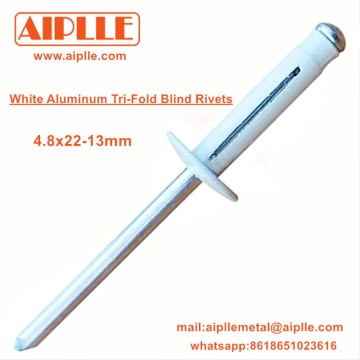
Galley units, lavatory enclosures, seating trim, and overhead luggage stowage racks are constructed from high-strength thermoplastic and Nomex honeycomb composite cores. Aesthetic-coated white aluminium tri-fold rivets distribute joint forces evenly, ensuring compliance with FAR 25.561 crashworthiness and dynamic G-force acceleration criteria.
Conditioned air ducting, rubberized vibration isolation collars, and titanium-to-aluminium flexible sleeve joints require leak-free, rattle-resistant fastening. Blind rivets accommodate soft rubber gaskets and thin aluminium flanges, maintaining air tightness without distorting the ductile ducting geometry.
The structural triumphs of lantern and tri-fold rivets in automotive volume manufacturing provide the rigorous baseline testing that validates aerospace composite-to-metal fastening.
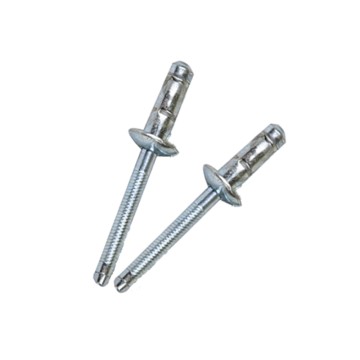
Lantern rivets are often used to connect components such as plastic instrument panels, interior trim panels and automotive interior decorations. These parts are mostly made of fragile or soft materials like plastics. The three folded feet formed after the riveting of lantern rivets can distribute the clamping force, avoiding damage to the riveted materials. Meanwhile, rivets with large caps can increase the riveting area and further disperse the riveting load.
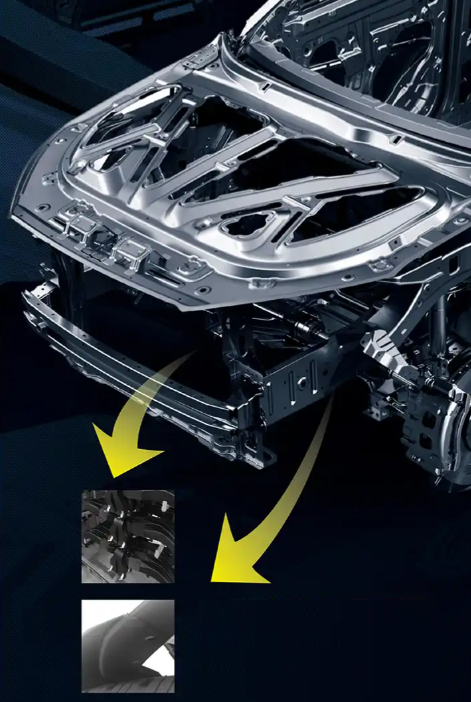
Lantern rivets are extensively applied in the assembly of automotive bumpers. They have good load - bearing capacity and stability, are suitable for connecting various metal and non - metal materials, and can meet the requirements of reinforced assembly between bumpers and vehicle body structures. In addition, lantern rivets are also used for fixing some automotive lamps, and their structure can provide reliable connection in vibrating environments.
In the automotive ventilation system, lantern rivets can be used to connect related components. The components of the ventilation system usually need to be connected with materials such as rubber and plastics, and the characteristics of lantern rivets make them well - adapted to these materials, ensuring the firmness and tightness of the connection.
Lantern rivets are also adopted for connecting the casings or brackets of electronic equipment inside the car, such as audio systems and on - board computers. They can realize the reliable connection of components like thin metal plates or plastic casings without damaging electronic components.
For some trucks or cars equipped with tarpaulins, lantern - type rivet nuts can be used to fix the tarpaulins. Their expanded structure has a large contact surface, which can fix the tarpaulins more firmly.
How next-generation materials and hybrid bonding architectures are redefining flight safety and structural lifecycle longevity.
The aerospace industry is adopting "Riv-Bonding"—a technique combining high-performance structural epoxy pastes with precision aluminium blind rivets. The chemical adhesive carries continuous shear stresses and seals out electrolytes, while the blind rivets supply instantaneous peel resistance and eliminate expensive prolonged tooling clamping fixtures while the resin cures.
To withstand supersonic boundary-layer friction and marine salt-fog corrosion in naval aviation, future aluminium blind fasteners utilize plasma electrolytic oxidation (PEO) and functionalized nano-zirconia barriers. These coatings offer exceptional dielectric insulation to eliminate carbon-fiber galvanic degradation across 30+ year airframe design lives.
Global aerospace OEMs are transitioning toward closed-loop circular production models. Monomaterial aluminium architectures joined by compatible high-grade aluminium blind fasteners enable single-stream recycling at end-of-life aircraft decommissioning, bypassing labor-intensive manual fastener extraction required with titanium or cadmium-plated steel rivets.
Engineered to rigorous ISO and aerospace quality standards for mission-critical structural reliability.